What exact rules you personally need? 
1 Like
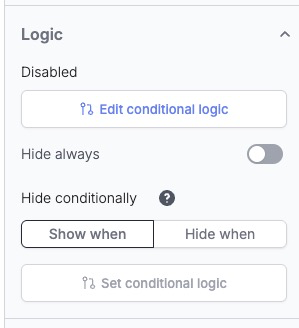
I don’t know if this is what the OP meant but for me its the conditional display and conditional disable of buttons. i.e. the ability to structure conditions which make the buttons visible/hide and/or disabled. This is massive to stop users triggering actions that they really shouldn’t until some conditions are met.
Ideally the conditions would work exactly like filters using all the linked entities etc however, even if its only based on fields of the entity itself it would be extremely helpful.
This is implemented very well by Fillout for example.

5 Likes
|
|
Didier Lahay reacted to your message: |

This is our main need as well, regarding rules for entity views. A couple examples. For our wiki, we’d love to have one view for document/entity editors and another view for everyone else. For the second example, we have two departments sometimes working on the same entity, but have different fields that are relevant for them. Setting view by user role would allow this to work very well.
1 Like
This is/was already possible - if no rules apply, and a user chooses an entity view, then this will be remembered for all entities of that type. So once your ‘editors’ have chosen the entity view they prefer, Fibery will remember that. Anyone else can just stick with the basic entity view (or choose one that they like).
One piece of feedback:
While editing a rule it would be nice to have an option of “Pin if Active” which would Pin the view in order that the views were arranged. This would allow the vies that are not relevant to stay hidden in the more views dropdown and the View that is relevant to be with the other tabs.
Current

Proposed

I always love quality of life improvements. Thanks for fitting this one in this quarter!


Hello and congratulations on these updates!
The product’s evolution is truly a model of success. I’ve already had the chance to tell you this, but each time you manage to deliver exactly the improvements we need, even without us asking. The latest one is this ability to open a view based on some field value.
I’d like to share two more general thoughts about the product, in case they might be useful.
The first concerns the Whiteboard. As a Figjam user since the beginning, I didn’t really see the point of this feature in Fibery, which always seemed a step behind in terms of functionality. We help our clients define target functional architectures and quite often need to document their processes, financial flows, functional or application architectures through diagrams. Of course, there are specialized tools, but none really cover our needs. With Figjam (or PowerPoint…), the difficulty is often the same: we present the same information from different, interconnected perspectives. If we need to update or add information, all diagrams and presentations potentially need updating. The risk of inconsistencies is high, and many representations quickly become obsolete. This is where Fibery seems to make a real difference by linking data and graphical representations. To get the most out of it, however, we are missing at least two functions that exist in classic views: the ability to filter the entire board based on criteria, and the ability to add color codes to entities displayed, based on criteria. I don’t know if this is the direction you want to take the Whiteboard, but it seems to me this is where you could stand out from other tools.
My second point is more about sharing a trend we notice among our clients, which might help you in the difficult positioning of your solution. We mainly work for asset management companies or private banks of significant size, which therefore have substantial resources. Since I started working, some vendors have unsuccessfully tried to offer RAD-type solutions, which always ended up stuck between more robust answers from IT departments and Access or Excel directly used by business teams. In recent years, vendors like Anaplan (mainly) or Pigment, positioned on planning and budgeting, have managed to establish themselves directly with business teams, with little (or no) involvement from IT. Although not originally designed for this, their flexibility in design and intelligent modeling approach mean I see many teams relying on such solutions far beyond their initial purpose of planning and budgeting. It may seem surprising to compare these solutions to Fibery, since they are built around multidimensional data engines more suited to consolidation or planning, in any case for more analytical use but they are actualy used to support all kind of business processes. Fibery is originally more “relational,” but I wonder to what extent, or how, it could address more analytical / multidimensional / calculations needs, beyond what “Reports” currently offer. For example, I’m not sure calculated fields (which are the main way to build dynamic aggregations) would perform well with large volumes of data and it is very limited if you want to be able to analyse on different dimensions.
Sorry for this overly long message, but I hope it can be useful to you.
I’m also seconding the need for user context. For example, we’re thinking about a multi-lingual content use case, where the correct tab would be determined by user’s language.
1 Like
added
Thank you!
Specify which Entity View to open for a user or a group released today March 5, 2026 / 🙈 Hide Entity Views with rules, Specify which Entity View to open by default for a user, Validation rules on Create
1 Like
Specify which Entity View to open for a user or a group released today March 5, 2026 / 🙈 Hide Entity Views with rules, Specify which Entity View to open by default for a user, Validation rules on Create